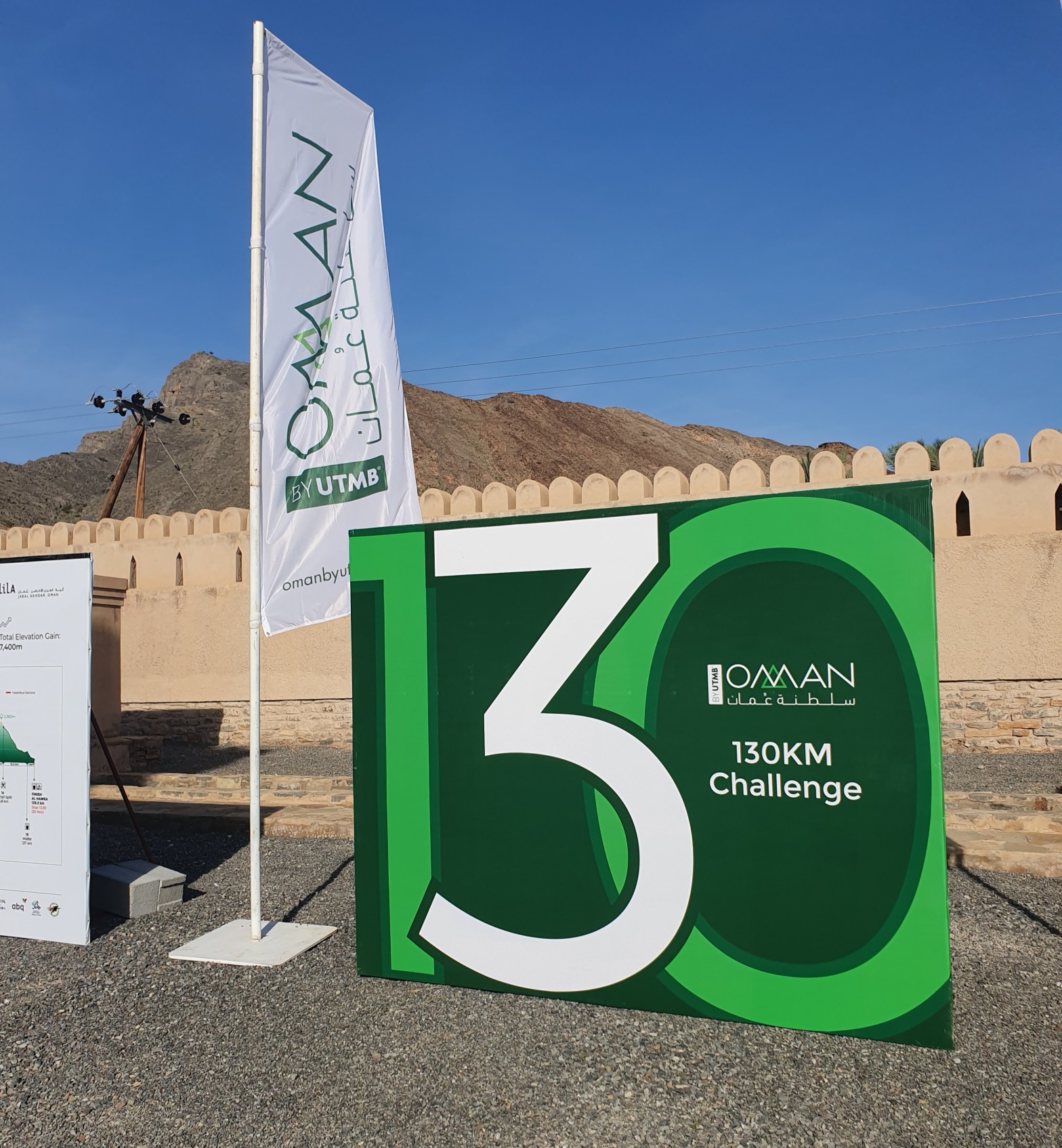
An epic journey of 18 months and 39 hours…
Background
The journey to the Oman by UTMB 130K race, which took place from 28-30 November 2019, didn’t begin when I registered for the race back in September 2019. It began back in the summer of 2018. And what a journey. Settle in. This is going to take a while. But context is important, particularly in a first blog posting.
A lot of things happened in my life in 2018. I’m not going to explore all of them here but a few crucial events led me directly to this race in Oman in 2019.
I ran the Mont Blanc 90K race in Chamonix in June 2018 and I loved it. It reminded me how much I loved running in the mountains, particularly the Alps. I knew that despite the technical elements of these runs and the relatively slower pace they resulted in, they were the runs that made me feel alive. Not just alive, but enthusiastic about life. That feeling is very important to someone with depression. Feeling that anything and everything was possible. Not all races made me feel like that. Some were about achieving a certain finish time or pace or placing, that quite frankly, sucked some of the joy from the whole event. I knew yet again at this race where my heart lay and I knew once again that it was imperative that I take part in the UTMB. The desire and drive to do the UTMB had begun a few years previous, but now, it was an all encompassing desire that I couldn’t adequately explain to those around me. I still can’t. It’s just one race. For me, it’s a race that has gotten under my skin. A 106 mile journey around Mont Blanc, through the beautiful mountainous landscapes of three countries. It’s busy and you’re rarely completely alone during the race – things I usually dislike! But for some reason, I love it all.
I had a brilliant summer of training after the Mont Blanc 90K race and was getting ready for the Swiss Peaks 170K in September 2018. Unfortunately my running prospects came to a crashing halt in August when I had knee pain that led to an MRI, that led to a diagnosis of severely diminished cartilage behind my Patella. This cannot be repaired or improved upon and will only continue to deteriorate. It had caused a hairline crack in my Patella that would repair, but would likely occur again and again without caution in my activities. I was faced with an Orthopaedic Surgeon who said that my running days were seriously numbered and I should really think about stopping doing the activities I loved. His referral to a Physiotherapist for rehabilitation was the best outcome he could offer. The myriad of thoughts, feelings and emotions that this stirred in me is hard to put into words. Yes, worse things happen to people and you try to put it into perspective, but when you know something is crucial to how you keep yourself both physically and mentally healthy, it’s hard not to lose the plot just a little bit!

My appointments with the Physiotherapist were a little like counselling rather than Physio. He talked me through the reality of the situation. Ultimately though, he said that there were no guarantees of anything and I should make my decisions about what I wanted to do – if I wanted to continue running, then I should. With some adjustments. In short, road running should be at an absolute minimum. Descending from mountains or in fact any downhill running needed care and attention. Not the wild abandon descending that I used to enjoy. That was over as it would likely result in another patella crack, especially if any jumping was involved. Quad strength was crucial, to take as much stress from the knee as possible. Longer, slower paced running would be better than the higher speed, higher energy forces required for shorter, faster paced races.
Overall, the message was: life is short. Enjoy the activities that bring you joy whilst you can. I could stop running and possibly preserve the life of knee for longer. Was this guaranteed? No. So, what was the point?
Many other things were going on in my life around the same time as the diagnosis about my knee. All of these things contributed to the most serious and rapidly descending bout of depression that I’d encountered in a few years. Suffering from depression when things in life are good is hard. Dealing with it when things in life were tough felt virtually impossible. A failed attempt at suicide in October 2018 was a turning point. I knew that the delicate balance between me feeling mentally well and very unwell needed constant attention. That attention would need to span across all areas of my life. It’s still a work in progress! However, I got one of those areas right pretty quickly. My running. I knew what I needed to do….
What I needed to do was focus on that love I had at the Mont Blanc 90K race. I wasn’t overly worried about my race time (other than achieving the pretty tight race cut off times in the early sections) and I wasn’t really focused on my placing. I had some success at placing well and some podium finishes in UK based races but that no longer seemed as important to me. At all. Running for the love of it was more important than where I would finish in a race. When podium finishes or being competitive in the race field aren’t possible anymore, for whatever reason, how do you retain focus? You need the love of the run, not just the competition. I wanted to be out in an environment I adored, doing what I loved. With like minded people. I knew that was more than sufficient to contribute to my mental well-being. Being competitive would have to be for other runners now. I couldn’t descend downhill as I wanted to now so that would necessitate a slowing down. And yes, it’s fair to say, well, why enter a ‘race’ then? Why not just go run the route on your own? The answer is simple. Not feeling that you can be as competitive does NOT take away the buzz of being in a race. Having people all around you, all battling through their own physical and mental challenges for the common goal of reaching the finish line. It’s a fantastic experience. And even when you’re not at the sharp end of ‘competition’ there will always be little races within the race. I can’t deny that I still look to my Veteran age category grouping and where I might finish in that in a race. There are certainly still possibilities there, but that will never be the main focus now.
I knew therefore that with the knee issue and the mental health issue, the importance of doing something I was truly passionate about was crucial from that point forward. It would never be sufficient to do an event that would just gain me a certain finish position but likely be a miserable experience along the way. UTMB became the driving force. There is a list of races beyond that, of course. Fundamentally though, if the thought of participation in a race doesn’t get me excited and give me butterflies, then I just won’t enter it. The love has to be there, or what’s the point?
So, with all of that in mind, the decision to enter UTMB was an easy one. In all honesty, 106 miles with 10,000m of ascent and descent is a pretty crazy idea for someone with a knee condition. But therein lies the crux of the matter. The crux of the whole of this blog really. Doing this stuff is what I love, what helps keep me mentally healthy. So I must strive to find ways to do it. Battle against the odds and never give up.
UTMB 2019
I was delighted that the plan was coming together when I found out I was successful in the ballot for the 2019 UTMB race. Training at the start of 2019 didn’t exactly go to plan, with some recurrent viral infections holding me back. That situation improved from February 2019 onwards and I trained hard, under the guidance of my brilliant coach Paul Giblin, for the remainder of the time until the race in late August. It wasn’t all plain sailing of course. I developed Plantar Fasciitis (PF) in my right foot in June 2019 and despite my best efforts at resolving it, I have had it since. It flares up badly at times and then settles down. A recurring pattern of annoyance and pain. A 3 day recce run of the UTMB route in early August (4 weeks before the race) showed me that the PF was something I’d just need to contend with during the race. In reality though, as is often the case, the thing you worry most about in a race, becomes the least of your worries and is overtaken by something different and unexpected.
A couple of days after finishing the UTMB recce run, I had the worst episode of vomiting and diarrhoea that I have ever had. Most likely a virus picked up staying in a hostel on the final night of the trip. About a week after recovering from this, I realised I had some of the symptoms of a Urinary Tract Infection. I didn’t want to take antibiotics less than 3 weeks before a big race so I tried everything possible to rid my body of it naturally. With the benefit of hindsight (always a wonderful thing) I realised this was a key mistake in my final preparations for a 106 mile race. I ended up needing the antibiotics anyway, but by the time I got round to taking them, the race was less than 2 weeks away. I travelled to Chamonix and felt that some of the symptoms still hadn’t cleared entirely. I tried to deal with this with the help of a pharmacy in Chamonix, but it was probably all just a little bit too late.

I started the UTMB race on Friday 30th August and expected to take somewhere between 37 and 42 hours to finish. However, from the very start of the race on the Friday evening, my body didn’t feel right. Something was ‘off’. I found myself breathing heavily on the early climbs and sweating profusely. I attributed this to the unusually humid conditions and it would be fair to say that I wasn’t the only runner appearing to experience this. Conditions overnight were still pretty humid, but I felt like I was moving well and was largely on target.
However, by mid morning on the Saturday, my condition had deteriorated. I didn’t feel that my physical condition equated to the stage of the race I was at. Coming into the large Aid Station at Courmayeur in Italy (approximately 50 miles) I knew I needed to spend a little bit longer there than I would normally spend at any Checkpoint or Aid Station in a race. I ate well, took on lots of fluid, changed my top and my socks and felt upon leaving that I could turn things around. Sadly, by the time I reached the opposite side of Courmayeur town, before the next big climb, I knew once again that things in this race were just not right. The trail was swaying in front of me as I was so dizzy and lightheaded, I felt sick, I was sweating profusely and moving very, very slowly. I made it to the top of that climb and sat down at Refuge Bertone, trying to decide what to do. I decided to continue for the next 10k or so, to Refuge Bonatti. The section of trail between these two mountain Refuges is some of the most stunning you will find anywhere. The Italian Alps are simply jaw dropping and on a warm sunny day such as that, are just life affirming in their beauty. My condition on the trail along to Refuge Bonatti continued to deteriorate so that by the time I reached the last steep section of trail leading up to the Refuge entrance, my legs were giving way beneath me. I was taken into the Refuge by the medics and assessed. Fast forward an hour and they were unsatisfied by my condition and the Race Dr they were on the phone to decided that I needed to be put on IV fluids. My race was over, they were withdrawing me. As soon as you require IV fluids in a race, you are removed from the race. Refuge Bonatti is only accessible by foot or Helicopter. As I was deemed unfit to continue 3 miles down the mountain to the next Checkpoint at Arnouvaz, they arranged Helicopter Evacuation back to Courmayeur and the UTMB Medical Centre at the large Aid Station there. After some medical attention there, I was sent back to Chamonix on one of the race buses, with a UTMB escort. Attending the Medical Centre back in Chamonix, the verdict was that it was likely the lingering effects of the Urinary Tract Infection had affected my hydration levels and any suspicion of Rhabdomyolysis had be to be taken seriously. Thankfully, my kidney function tested normal and I was cleared to go. Home. Physically in one piece. But with a slightly broken spirit. 100k covered, but some way off the 170k finish line.
I was upset. I hadn’t finished the big race which I’d fought hard to get to the start line of. With a race like UTMB, you can’t just choose to go back the next year and finish what you started. You need race points to enter the ballot and then you need to make it through the ballot, or lottery. The odds were against me. Even if I was hopeful about getting a place through the ballot, I didn’t have enough points to enter unless I did another race before the end of the year.
A chance comment from my friend Helen the day after the race planted the seed for doing the Oman By UTMB 130k race in November. The attraction? Guaranteed entry to the 2020 UTMB race, bypassing the lottery system for a place. This guaranteed UTMB place was the driving force behind doing the race, a means to an end. It gave me butterflies thinking about it though, so I knew it fitted my criteria for entering a race.
The Oman Race
After a brief period of rest to recover from the 100k I had covered at UTMB before being pulled from the race, training commenced for Oman. I trained hard, as usual, under Paul’s guidance. I also read every blog, watched every YouTube film and absorbed as much as I could about the event. It was very clearly not going to be straightforward. I knew that it would be tough….there’s no way an organisation like UTMB are going to let you bypass the lottery and automatically gain one of the sought after places at UTMB by completing a race that was easy to finish. Wow, I really had no idea though.
Oman 130k is listed as the world’s toughest trail race by National Geographic. I tend not to place much weight on these ‘toughest’ lists or scales, because they’re subjective. All race experiences are. Someone running a short race might have their own battles to fight. But yes, it was a brutal event. Relentlessly unforgiving terrain combined with a variety of dangerous exposed climbs and ridges. I decided from the outset that I was treating this as an adventure, an experience. Seeking a finish, not a particular time. I knew the very technical nature of it would mean that I’d have to be cautious in order to get a finish because of my knee condition. And crucially, to not fall off a cliff.
The build up to the race was again not straightforward (is it ever? For anyone, for any race?!) The Plantar Fasciitis I’d had since June was still hanging around and it had flared up A LOT whilst training for Oman. I’ve been managing it by attacking it from all angles, but probably wouldn’t have got to the race start without the help of my lovely Sports Massage Therapist, Sarah. Then, 11 days before the race, on a flat, innocuous bit of trail, I turned my ankle. Full sprain. Swelling, bruising, the works. Suddenly I didn’t know if I’d make the start line. But conservative management and help from Sarah again meant it was feeling ok by the time I was travelling out for the race.
Arriving in Oman and feeling the heat, a huge contrast to Scotland at the end of November, caused me to have a serious tummy flip. Another element of the challenge ahead.
The race started at 7.30pm on Thursday evening (3.30pm UK time) and I knew it would likely be sometime on Saturday morning before I finished. The start of the race was pretty exciting. There was loads of support from the local Omani people, who are extremely enthusiastic about the whole event. I can’t praise the Omani people highly enough. They are welcoming, warm and will do anything to help you.
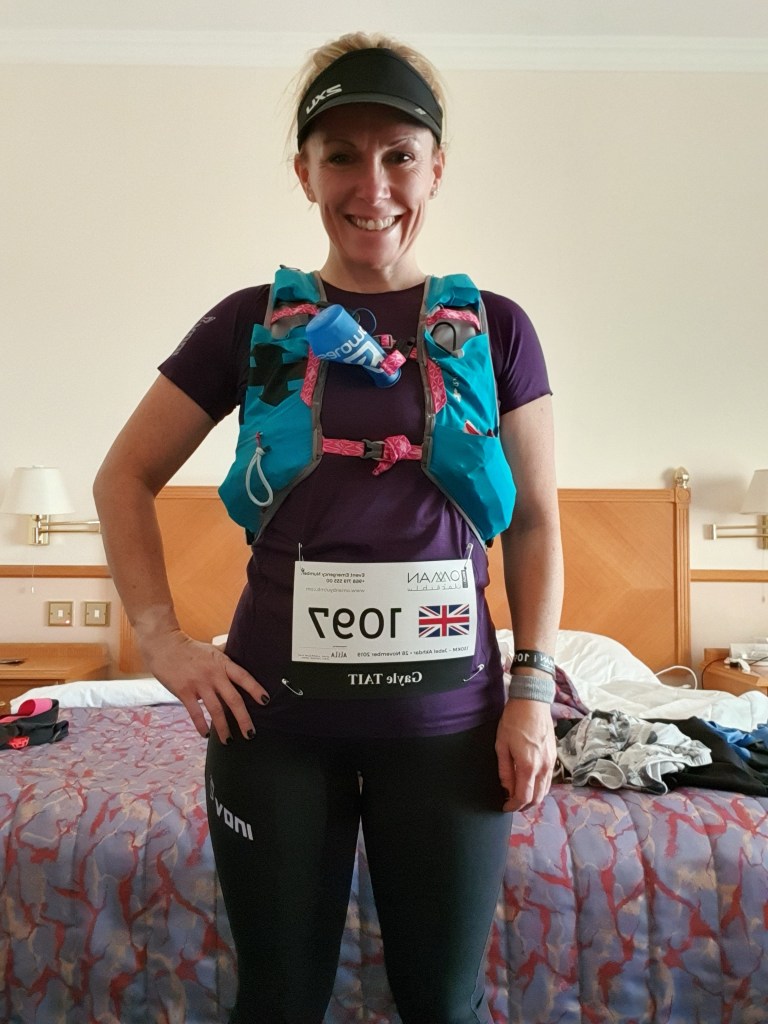
From the start at the Fort at Birkat Al Mouz , we skirted around the town before heading out on to trail. The local people had brought their children out, lined them up in height order at the side of the road to seek out ‘High 5’s’ from the passing runners. I sense that it’s not really in their culture to “whoop whoop” at things, but they did…they clapped, they cheered, they were amazingly supportive. I absolutely loved it. Those who perhaps didn’t know a huge amount of English still shouted support…I was told on numerous occasions during the race “You are good woman”. I suspect that’s the Omani equivalent of “Allez les Femmes” when running in France!
The first 12k was pretty tame in comparison to what was ahead. It was the most runnable section of the whole route. Heading into the first Wadi (a dried out ravine, or canyon) in the dark, was magical. I was very grateful to be there. The first night progressed well. I was feeling good, enjoying the darkness and the cool air in the mountains. I could see headtorches ahead and behind and had a few chats with other runners, but unlike UTMB, I was mostly alone. And I loved it. Quietness, the stars, amazing terrain all around by the light of head torch. Total contentment. Friends have asked if I get scared when I find myself alone in the dark, on a mountain. There is nothing to fear when you feel at peace with yourself.
Sunrise on Friday morning and I was heading into a massive canyon. The scale of which I’ve personally never seen or experienced before. An Omani goat herder/shepherd, was descending into the canyon at the same time and was keen to point out the race route to me. It would perhaps have been understandable, being a woman alone at that point in the mountains, to be a bit worried at this encounter. But I wasn’t at all. I felt extremely safe. And I can’t quite explain why. I just felt safe and not in the least bit intimidated. Five minutes later and he was just up the trail behind me…and I fell on a tricky bit of rock descent. Face forward, knee cut on the rocks and foot twisted and trapped in a rock behind me. Twisted at the ankle that I had sprained less than two weeks before. I thought my race was over. I sat for a few minutes to gather myself. The Omani herder waited behind me. He had virtually no English but showed his concern. The swelling started pretty instantly but wasn’t hugely painful. So I decided if I could go another mile or so with minimal pain, I’d continue. But I knew I needed to keep my shoe on from that point in the race. I couldn’t change socks at the life base as planned as I then might not get my shoe back on. This would become problematic later in the race due to some very fierce blisters. I kept descending into the bottom of the canyon, with the Omani herder behind me. I told him to go ahead as I was moving slowly, but he refused….he was keeping an eye to make sure I was okay. Just before I reached the bottom of the canyon, the Omani herder headed off in another direction, wishing me well. At this point, a French runner caught up with me and I wondered if I had imagined or hallucinated the whole episode. The kind Omani herder who was looking out for me on a tough descent? Bizarre. But I hadn’t imagined it. The hallucinating came later in the race…as it often does for ultra runners out for more than one night of constant motion.

The climb up out of that canyon was unbelievably tough. But the views were incredible. The Checkpoint at the top indicated it was another 12k or so to the Alila Hotel, the first big life base. It was at the top of another canyon and we had to descend into it, go up the Wadi, go up a huge rocky climb, scrambling most of the way and then undertake a Via Ferrata before reaching the Checkpoint. Via Ferrata is where there are fixed cables into dangerous sections of rock and you need a harness and Via ferrata clips and a helmet to cross it. This section, before the Via Ferrata, was some of the toughest trail I think you would encounter ANYWHERE. No exaggeration. The Via Ferrata was easy in comparison, despite being the section feared by most. There were loads of drop outs from the race at Alila life base, after that climb. And I can understand that. The thought of what had gone before and knowing there was more challenging sections to come, was incredibly difficult mentally. I’ve heard runners say that when you run in the Alps, you should allow double the time that you normally would for a distance. In Oman, it’s easily 3 times on some sections. I phoned my children after the race and my 11 year old daughter asked me “Mum, we were tracking you and you were very slow..why were some of the sections that were only 5k taking you two hours?!” My response “because, darling, I spent most of that bouldering up a rock face or scrambling through a Wadi…there was no running. Just forward movement.” I recently watched a YouTube film of GB Ultra Runners Robbie Britton and Dan Lawson undertaking a Fastest Known Time run of the 650k Jordan Trail and was encouraged to see even Elite Ultra Runners frustrated at their slow progress on the very technical trails, similar to Oman, in that part of the world!
The sun sets in Oman around 5.30pm. It doesn’t rise again until 6.30am. For those out for two nights in the race, this means 26 hours of head torch running. Mostly in difficult, and sometimes dangerous, terrain. I knew a big feature of my second night out on the course would be the climb up the mountain they called W8. This is essentially a Vertical Kilometre up an exposed mountain. In darkness.
Before getting to W8 I had a massive descent to cover. It was mostly on dirt track road and should therefore have been relatively easy running, making up some time from the slower sections before, and still to come. Unfortunately, the blisters on the soles of my feet which I had decided to ignore many hours before, were agonising by this point and running pace was very restricted as a result. The situation with my ankle sprain had assured me that taking my shoes off was a bad plan, so I had decided to let the blisters ‘explode’ inside my shoes. That 12k descent was painful. At the bottom of it, before I entered another Wadi, there was some sort of Social hang out for young Omanis. This meant there were a series of 4×4 vehicles descending down the rocky dirt road I was running down. A couple of vehicles filled with young Omani men slowly passing me whilst I was alone on the trail in the dark should have perhaps been a more disconcerting experience than it was. I stopped to let one of the vehicles pass on a narrow section and they lowered the window. They clearly knew about the race and politely asked me: “Ma’am, are you ok? Do you need help?” I replied that I was very well and was just giving them some space to pass. They wished me luck and off they went. They say Oman is the second safest country in the world. If the care and concern shown by their people is anything to go by, I can understand why this is the case. I felt looked after, rather than intimidated. I’m just not sure this would be the case if alone in the mountains in other parts of the world.
After this descent, and the climb through the Wadi at the bottom of it, I reached the second life base at Balad Sayt. A life base is simply a bigger Checkpoint, or aid station where it’s possible to sleep, recharge your phone or watch or head torch and with a selection of hot food. This one was at the base of the W8 climb and leaving it signalled the start of the climb. I don’t think it’s possible to overstate how dangerous some parts of this climb were. The width of the ‘Trail’ in some parts was quite simply no more than a wide side step. I barely skim 5 feet tall and yet if I’d side stepped just a little too far in some parts, I would have fallen to a certain death. I don’t say this for dramatic effect. It’s fact. I lost many places in the race during this section, which affected my overall placing in the race. Anytime I sensed someone behind me, I stepped into the side to let them pass. My main concern was safety, not speed.
I often wonder why I don’t feel fear on dangerous terrain like this. At all. I’ve wondered if it’s related to a history of depression and feeling suicidal. Feeling suicidal is very complex. To me, it has always felt scary. Terrifying. Perhaps in times when I feel happier and want to live, these dangerous experiences just don’t seem quite as terrifying as they might have. In fact, quite the opposite. Striving to get through, to succeed, to complete the task in hand is somehow a joyful experience.
Having completed the most dangerous section of the race, I knew the end was in sight. I was a little worried about time though. From having been many hours ahead of the Checkpoint cut off times, my caution on W8 had set me back slightly and I started to worry that further difficult and technical terrain would see me closer to the cut off times than I would be comfortable with. I knew that the race tracking at this point was predicting a 36 or 37 hour finish time, but I knew that my feet were in poor condition and this was unlikely as I couldn’t move as quickly as I wanted to over the more difficult sections. Everything was taking an inordinate amount of time.
My fears proved to be right and the next sections that appeared from the race profile to be ‘downhill’ were quite simply miles and miles of difficult rocky descending. I was certain that a large truck had just tipped rocks and boulders down what would otherwise have been perfectly runnable trail! However, the end was in sight and I started to think it was realistic for me to finish in 38 hours. The final section gave no reprieve from rock though and I finished in 39 hours and 14 minutes. 5th Female in my age category and well within the 40 hours I was aiming for.
The final hours of the race were filled with pretty extreme pain in my feet and hallucinations. Oh my goodness, the hallucinations. I had experienced a little of this during the UTMR race in 2017, but nothing on this scale. Omani people sitting at the side of the trail in traditional dress who turned out to be rock stacks, Alsatian dog heads appearing in rocks, faces in rocks, and Scooby Doo – he was everywhere. All tricks being played by a sleep deprived mind. All worth it though. Honestly.
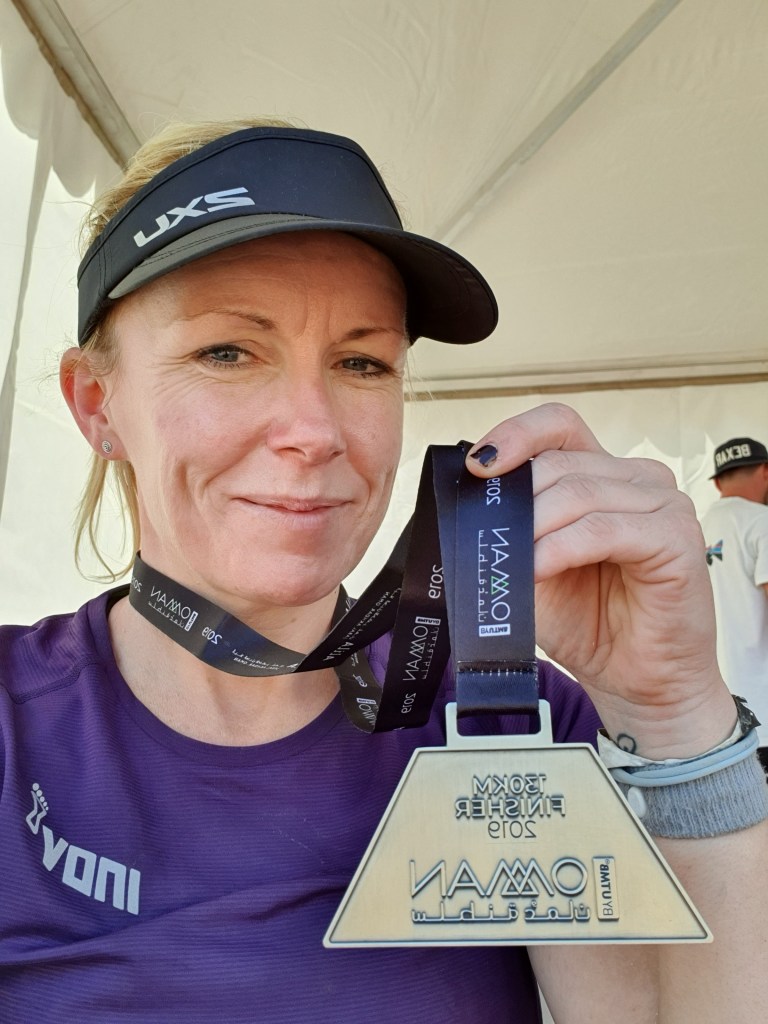
I was absolutely delighted to finish this race. It truly felt like the culmination of a whole lot of effort after a difficult 18 months. The message? Even from our lowest points, it is possible to pick ourselves up and move forward and succeed in our goals. If you are someone out there reading this that suffers from depression, or know someone that does and are struggling to understand it, you should know this:
Depression will hammer you down.
It will lower your resilience.
It will tell you that you are rubbish, that you are not good at doing the things you love.
It is not enough for me to tell anyone suffering from it that you can get through it and do anything you want to do. I won’t bother telling you that if you feel that way, because I know that in darkness, seeing the light can be difficult.
Hopefully I can show you though. Show you that it’s possible. If I can, maybe you can too.
 Running Through Thoughts
That was good, enjoyed reading that. Hopefully no mid race injuries next time 🤞
LikeLike
Love it all. Those last words? Want to pin to all my walls!
LikeLike
Great blog Gail! Loved it!
LikeLike